If you’ve ever stood in a warehouse, watched a crane hoist a 10,000-pound steel beam, or seen a farm worker use a chain to secure a load of hay across a bumpy dirt road, you’ve relied on welded link chain without even thinking about how much its surface finish matters. I’ve been a welded link chain supplier for over 18 years, and I’ve lost count of how many times a customer has called me panicking because a chain they bought a few months ago started cracking, rusting, or stretching way more than it should. Nine times out of ten, when I dig into their story, the problem traces back to the surface finish of their chain—something that’s easy to overlook when you’re focused on working load limits and price per foot, but absolutely critical to performance. Welded Link Chain
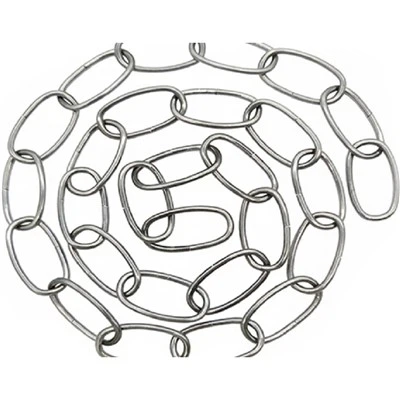
Let’s start with what welded link chain’s surface actually is. When we make a standard high-test or proof coil chain, we take raw steel bar, heat it to forging temperature, bend it into interlocking links, and weld the ends shut to create that continuous loop. That weld is the weakest point of any chain, right? But it’s also where the surface finish first shows its impact. Right after welding, most chains have a rough, uneven texture left from the forging process: tiny spikes of excess steel called “flash,” pits from impurities in the raw material, and residual scale that forms when hot steel hits oxygen in the air. If we leave that finish as-is, we’re not just leaving a rough edge—we’re building in hidden weaknesses that show up when the chain is under load.
Rust is the first big one. A chain that’s left with a rough, unpolished surface traps moisture, dirt, and chemicals in those tiny pits and crevices way easier than a smooth, finished chain. I had a customer up in Minnesota last year who bought a bulk order of proof coil chain from a competitor at a steep discount. Within six months, half the chain used for securing grain silos showed red rust along the links. When they sent samples back to test, the rough surface had allowed moisture to seep into micro-cracks that form at the weld, eating away at the metal from the inside. That kind of corrosion doesn’t just make the chain look bad—it weakens the steel’s tensile strength by as much as 30% in some cases, per test data we’ve run in our in-house lab. A smooth, properly finished chain, on the other hand, has no pits to trap moisture, so it resists rust far longer, even in outdoor, high-humidity environments. That’s why we offer two different surface finishes for most of our chains: unpolished for customers using them in dry, indoor settings like factory conveyors, and pickled and passivated for outdoor or marine applications.
But surface finish affects more than just corrosion resistance—it also plays a huge role in how the chain holds up under repeated stress, which is called fatigue strength. Think about a chain on a crane that’s lifting heavy loads all day, or a chain on a farm tractor that’s pulling through fields for 12 hours straight. Every time the chain stretches and relaxes, every twist and jolt as a load moves, that’s stress being applied to the metal. A rough surface acts like a thousand tiny scratches, each one a stress concentration point where tiny cracks can start to form. Those cracks grow over time, even at loads below the chain’s official working limit, until the link breaks. I’ve seen this happen to chains used for towing: a customer once told me his old chain broke while he was pulling a stuck truck, and when we examined the broken link, the fracture started at a rough, unbuffered edge from where the chain had been cut to length and not smoothed. A finished chain, with rounded, smooth edges, distributes that stress evenly across the entire link, so those tiny cracks never have a chance to form. Our test results show that a properly polished welded link chain has 25-40% higher fatigue strength than an unpolished chain of the same grade. That’s a huge difference when you’re talking about a chain that needs to last for years of heavy use.
Another thing a lot of customers don’t realize is how surface finish affects how the chain interacts with other equipment. Chains run on sprockets, wrap around pulleys, or rub against other metal parts when they’re in use. A rough chain will cause more wear on the sprockets or pulleys it works with, because those tiny spikes dig into the other metal and cause abrasion. But it also wears itself out faster. If the surface is smooth, the chain glides against the sprocket evenly, so both the chain and the equipment last longer. We had a mining customer switch to our fully finished alloy steel chains a few years ago after they were replacing sprockets every six months because of excessive chain wear. After switching, their sprockets lasted two and a half years, and their chain failure rate dropped by 70%. That’s not just a win for the chain—it’s a win for their entire operation, no more downtime waiting for broken chains or worn sprockets.
Wait, let’s talk about different types of welded link chain, because surface finish matters differently for each one. For example, a transport chain used to secure loads on flatbed trucks has different requirements than a chain used for overhead lifting. Overhead lifting chains can’t have any rough edges at all—OSHA has strict rules about that, because a rough link can catch on a load, slip, or break under load. We make our Grade 80 overhead lifting chains with a ground and polished finish to meet OSHA standards, and every link is inspected for surface smoothness before it leaves our warehouse. For transport chains, we offer two finishes: hot-dip galvanized, which is a common finish that adds a layer of zinc to resist corrosion, and polished plain steel for customers who want a smooth surface that’s easy to handle and won’t scratch the load they’re securing. A lot of new customers ask if galvanized is the same as a smooth finish, and I always explain that hot-dip galvanizing does add a layer of protection, but it can leave a slightly uneven texture if not applied correctly. That’s why we make sure to buff any excess zinc off our galvanized chains so they’re smooth enough not to scratch wood or paint on vehicles.
I’ve also learned over the years that surface finish ties directly to quality control, which is something every supplier should take seriously. When a supplier skimps on the finishing step, they’re not just cutting costs—they’re cutting corners on safety. I once had a customer who brought in a broken chain from a job site, and when we examined it, the link had a deep pit at the weld that had started as a forging flaw, hidden under a rough surface that the other supplier never sanded down. That chain should have been rejected before it ever left the factory, but because of a poor surface finish, a small flaw turned into a catastrophic failure. For us, finishing is non-negotiable. Every chain we make goes through three steps after welding: first, we blast it with glass beads to remove scale and surface impurities, then we polish the links to a smooth, uniform texture, and finally, we apply whatever protective finish the customer needs—whether that’s paint, zinc, or just a light oil for indoor use. We do this not because it’s extra work, but because it’s how we ensure our chains perform as promised, every single time.
Let me give you a real example that sticks with me. A few years ago, a construction company called me looking for a replacement for a chain they’d been using to hoist steel beams on high-rise projects. They were going through a new chain every three months, even though they were using a reputable brand. They sent a sample of the broken chain, and when I looked at it, the weld area was rough and pitted, and the chain had not been polished at all. I offered them a few yards of our Grade 100 polished lifting chain to test. Three years later, they called me to place a 500-foot order, saying that same test chain was still going strong, no cracks, no rust, no stretching, even after being used 10 hours a day, five days a week, lifting 20,000-pound beams. That’s the difference a good surface finish makes—turning a chain that fails every few months into one that lasts for years.
I know what a lot of you are thinking: “Surface finish is just a cosmetic thing, right? It doesn’t affect performance.” But after 18 years in this business, I can tell you that’s not true. It’s one of the most impactful, yet most overlooked, factors in welded link chain performance. When you choose a chain, you’re not just buying a length of metal links—you’re buying a piece of equipment that has to hold heavy loads, stand up to weather and wear, and keep workers and cargo safe. A rough, poorly finished chain might cost a little less upfront, but in the long run, it costs you more in replacement parts, downtime, and even safety risks. A properly finished chain might cost a few cents more per foot, but it will save you money and headaches for years.

At the end of the day, that’s why I do this. I don’t just sell chains—I help businesses keep their operations running smoothly, keep their workers safe, and get the job done right. If you’re in the market for welded link chain, whether it’s for lifting, securing loads, farming, mining, or any other application, I’d be happy to talk through your needs, explain the different surface finish options we offer, and help you pick the right chain for your job. Don’t let a rough, untested chain put your team or your cargo at risk. Reach out anytime to get started.
Clothes Rack References
American Welding Society. (2020). Welded Link Chain Quality Standards. AWS B10.10-2020.
Occupational Safety and Health Administration. (2022). Overhead Lifting Chain Safety Requirements. OSHA 1926 Subpart N.
Steel Chain Institute. (2021). Surface Finish Effects on Steel Chain Fatigue and Corrosion Resistance. SCI Technical Report 017.
Pujiang Shenli Chain Co., Ltd.
We’re well-known as one of the most experienced welded link chain suppliers in China, featured by quality products and low price. Please feel free to buy discount welded link chain made in China here from our factory. Contact us for more details.
Address: No. 18, Zaifeng Road, Pujiang County, Zhejiang Province
E-mail: Chen@shenlichain.com
WebSite: https://www.chainshenli.com/
